

There isn’t one best UAE location for every investor. A considered UAE real estate investment strategy starts by matching the area and property to your priorities, whether you’re seeking rental income, future resale or a home for your own use. Dubai may suit your plans, but the right choice depends on the property, its location and how you intend to hold or rent it.
It’s natural to focus first on a popular city or promising development, but the decision becomes clearer when you compare practical factors such as tenant demand, connectivity, ownership options and the time you can devote to managing a property. Each can shape how well an investment fits your objectives.
This guide explains how to compare Dubai with other UAE locations, weigh short- and long-term rental approaches, understand ownership choices, and assess residential, commercial, off-plan and holiday-home properties. You’ll have a clearer framework for choosing a direction that aligns with your investment goals and comfort with ongoing management.
Key Takeaways
- Compare UAE locations by tenant demand, connectivity and future development, then assess whether an off-plan property fits your goals and risk tolerance.
- Weigh short-term rental potential against seasonality, occupancy and management needs before choosing a letting approach.
- Explore how different ownership routes affect your investment’s liquidity, control and exposure to risk.
- Match residential, commercial, off-plan or holiday-home property to your intended use, investment horizon and management capacity.
1. Which emirates or cities (e.g., Dubai, Abu Dhabi) offer the best property investment opportunities?
Dubai is a strong place to assess, but the best location depends on your investment aim. The city recorded 180,900 real estate transactions, valued at over AED 522 billion, in the last 12 months. Transaction value also increased by 36% over the previous year. These figures show activity, not a guarantee of future appreciation, so compare neighbourhood demand, amenities and your intended holding period.
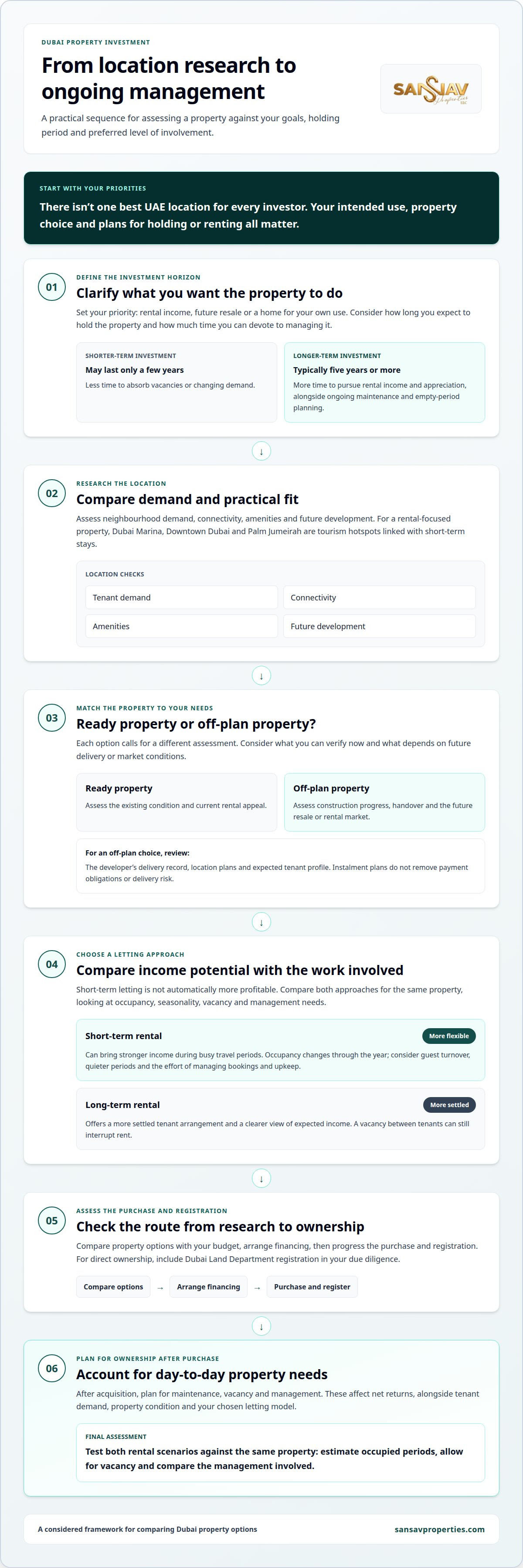
For a rental-focused property investment, Dubai Marina, Downtown Dubai and Palm Jumeirah are tourism hotspots linked with short-term stays. That approach can suit investors seeking flexibility, but income depends on occupancy, seasonality and management needs. A short-term investment may last only a few years, leaving less time to absorb vacancies or changing demand. Long-term investment, typically held for five years or more, gives you more time to pursue rental income and appreciation, but requires ongoing maintenance and a plan for empty periods.
Off-plan and ready properties suit different priorities. A ready home lets you assess its existing condition and current rental appeal; an off-plan property depends on construction progress, handover and the future resale or rental market. Some Dubai developers offer instalment plans lasting 4-5 years, but payment obligations and delivery risk still belong in your assessment. Review the developer’s delivery record, location plans and expected tenant profile before choosing.
Property investment may also support a residency application. The UAE Golden Visa is a 10-year residency permit, according to the Federal Authority for Identity, Citizenship, Customs & Port Security. A property investment worth over AED 2 million is stated as qualifying for the Golden Visa.
Follow a clear sequence: research the area and upcoming developments, compare property options with your budget, arrange financing, then progress the purchase and registration. After acquisition, plan for maintenance, vacancy and management, since each affects net returns. Dubai’s transaction activity can guide market research, while the property’s condition, tenant demand and operating needs shape the day-to-day decision.
2. Are short-term rentals more profitable than long-term rentals in Dubai?
Not necessarily. Short-term lets can bring stronger income during busy travel periods, but occupancy changes throughout the year. In the UAE, short-term rentals are commonly let for brief stays on a weekly or monthly basis. Tourism demand can support frequent bookings, while quieter periods may leave a property empty and reduce annual returns. Expected occupancy matters more than a headline nightly rate.
Compare both approaches using net returns, not rental income alone. Gross yield compares annual rent with the property’s purchase value; net returns also account for service charges, maintenance, financing, vacancy and management fees. Some UAE property areas offer rental yields of more than 6% to 8%, but this figure does not establish what a specific Dubai home will earn. Occupancy and operating commitments influence the result.
Short-term letting may suit a well-presented home in an area with regular visitor demand, if you can oversee changing bookings and upkeep. Flexibility can also mean more frequent guest turnover and periods without bookings. Long-term rental offers a more settled tenant arrangement and a clearer view of expected income, though a vacancy between tenants can interrupt rent. Each model brings different demands on your time and property management.
For a buy-and-hold investment, assess rental income and capital appreciation separately. A home’s value may change over time, while rental performance depends on tenant demand, condition and the letting model. Compare annual rent, likely occupancy and ongoing management commitments. Then choose the approach that fits your investment horizon and preferred level of involvement, rather than assuming short-term letting always pays more.
A practical way to decide is to test both scenarios against the same property: estimate occupied periods, allow for vacancy and compare the management involved. This gives you a clearer view of potential income, capital tied up in ownership and the balance between convenience and flexibility.
3. Can I invest in Dubai real estate without buying an entire property?
Yes. Fractional ownership lets several investors pool funds to participate in a property rather than buying it alone. This can reduce the capital needed to access a larger development, but you may have limited control over decisions and difficulty selling your share. Review the ownership structure, decision-making rights and exit arrangements before committing.
Real Estate Investment Trusts (REITs) offer another route: they provide exposure to property without direct ownership of a physical home. REITs can offer diversification, liquidity and passive income, though their performance still depends on the properties and market behind them. Dubai real estate tokenisation is also developing through regulated initiatives involving the Dubai Land Department and other authorities. Consider legal structure, liquidity, platform risk and attached rights.
Direct ownership remains an option for foreign investors in Dubai’s designated freehold areas, where they can own 100% of a property. Buying a share through a pooled arrangement is different from holding the registered title directly, so understand which rights attach to your chosen route. Dubai Land Department registration is part of a direct property purchase; include the registration process in your due diligence.
Use Dubai’s real estate market performance and infrastructure plans as research inputs, not as a substitute for assessing a specific asset. The Dubai Real Estate Sector Strategy 2033 aims to raise market value to AED 1 trillion, grow real estate transactions by 70% and increase homeownership to 33%. These targets indicate policy direction, while local demand, upcoming developments and economic conditions affect individual locations differently.
Manage risk in a clear order: define your investment objective, compare ownership structures, research the property and its location, then assess liquidity, control and ongoing obligations. For a direct purchase, include title registration, ownership rules, visa implications and tax considerations in your legal due diligence. For fractional or tokenised property, examine how decisions are made and how you can exit. This helps you judge whether partial exposure fits your portfolio better than buying and managing an entire property.
4. Residential, commercial, off-plan, and holiday-home investments
Residential property can serve different roles within your portfolio. A city-centre apartment may suit buyers prioritising an urban home, whilst a villa in a green landscape may better match family living. Compare the intended occupants, layout and access to amenities, then decide whether the property complements your existing assets. This approach keeps the choice grounded in the home’s purpose, rather than selecting a property type simply because it is familiar.
Commercial property calls for a different lens. Offices, warehouses and development land serve distinct business uses, so consider the likely occupier and whether the property suits that activity. A commercial lease may suit an investor seeking a business-focused asset, while residential property serves a different market. Compare each option’s role in your portfolio and the expertise needed to assess it, rather than treating commercial and residential opportunities as interchangeable.
Off-plan property can form part of a portfolio built around a specific future use. First identify whether you envisage a residence, rental asset or future resale, then assess whether the development’s setting and amenities align with that purpose. This frames the decision around the asset you want to hold, without assuming every development suits every investment objective.
A holiday home has a distinct appeal for investors who value a property that can also serve personal stays. Consider how its location, layout and nearby attractions suit the experience you want the home to offer. Set out your personal-use priorities alongside the investment purpose, since those choices shape how the property fits your wider plans. Across all four types, the clearest choice is the one whose intended use, features and place in your portfolio align with your priorities.
SANSAV Properties LLC: Off-Plan Property Investment
SANSAV Properties LLC offers Off-Plan Property Investment for investors considering a purchase before construction is complete. Turn to the team when you want to discuss how a development, location and intended rental or resale approach fit your investment goals. Professional Real Estate Consultations can help you weigh those priorities alongside the trade-offs of buying off-plan.
If a completed home better suits your plans, Secondary Market Residential Sales offer another route to explore. Residential Rental Listings can also help you consider available homes as part of your property search. These options support different decisions, from assessing a future development to comparing a ready residence or rental opportunity.
To take a considered next step, contact SANSAV Properties LLC to discuss your property investment plans.
Shape your next property decision with confidence
Let your investment priorities guide what comes next. As your plans evolve, the role you want a property to play may change, whether you’re building a portfolio or considering a home for personal use. An effective UAE real estate investment strategy leaves room to reassess your priorities before making another commitment.
Set a clear decision framework: define what matters most now, identify the trade-offs you’re comfortable with, and consider how a property would fit your wider plans. SANSAV Properties LLC can bring its real estate expertise to a conversation about turning those priorities into a practical next step.
When you are ready to explore your options, contact SANSAV Properties LLC to discuss your options. A considered conversation can help you move forward with greater clarity and confidence.
Frequently Asked Questions
Which emirates or cities offer the best property investment opportunities?
There is no single best city for every investor. Compare Dubai and Abu Dhabi by the purpose of your purchase, the property types available and the residents or businesses each area is designed to serve. A family home, a visitor-focused residence and a commercial asset call for different location criteria. Start with your intended use, then narrow your search to places suited to it.
Can I invest in Dubai real estate without buying an entire property?
Yes. You can explore indirect property exposure through a Real Estate Investment Trust or consider fractional ownership. Before choosing, establish what you would own, how decisions are made and how you could exit the investment. These details distinguish an investment linked to property from direct ownership of a specific home and help you judge whether the arrangement fits your preferred level of control.
Why is the UAE an attractive destination for international property investment?
The UAE offers a range of property types and investment approaches, allowing you to consider residential, commercial and development opportunities within one national market. Its appeal depends on what you’re seeking: a home, rental income or a business asset. Compare how each option aligns with your investment horizon and appetite for direct involvement, rather than assuming one market-wide advantage suits every investor.
Are short-term rentals more profitable than long-term rentals in Dubai?
Not in every case. The better fit depends on how the property serves its intended guests or tenants and how actively you want to oversee its use. A home designed for brief visits may suit one operating plan, while a residence suited to longer occupancy may fit another. Compare the property’s features and your preferred level of involvement before settling on a rental approach.
Can foreign investors own freehold property in the UAE, and in which areas?
Foreign investors can own 100% of property in designated freehold areas of Dubai. This answer is specific to Dubai and does not establish the same rule throughout the UAE. For a particular purchase, distinguish the area’s ownership category from the property’s other attributes. Understanding the title and the rights attached to it helps clarify what your ownership will cover.
How can I create passive income by renting out my property in the UAE?
Prepare the property for its intended occupant, set clear expectations for upkeep and establish a reliable process for handling tenant or guest needs. Planning maintenance and record-keeping in advance can reduce day-to-day involvement, though rental ownership still requires oversight. SANSAV Properties LLC offers Residential Rental Listings to help you explore available rental opportunities as part of your property plans.


