

Foreign buyers can own 100% of a property in designated freehold areas, although the applicable rules depend on the emirate and location. For UAE property investment for beginners, choosing the right type also means weighing residential, commercial and off-plan options against your income goals, management capacity and timeline. The UAE offers several routes, but each calls for careful comparison.
It’s natural to want a clear starting point when considering a major investment in a market with varied property options. This guide explains how to compare apartments, villas, commercial properties and off-plan developments, assess investment potential, and understand where foreign ownership applies. Use this practical framework to match a property to your goals and make your next decision with greater clarity.
Key Takeaways
- Compare residential, commercial and off-plan options against your income goals, management capacity and investment timeline.
- Assess rental yield by both property type and location, and factor Dubai Land Department registration and transfer costs into your calculations.
- Foreign buyers can own property in designated freehold areas; understanding where those areas apply is central to choosing a suitable investment.
- Use the differences between ready and off-plan property to shape your next step, then explore professional guidance that aligns with your investment priorities.
What type of investment property is most profitable?
Profitability depends on whether you prioritise rental income, capital appreciation or both. For UAE property investment for beginners, compare expected yields, ownership costs and management needs before choosing a property.
-
Compare yields by area and property type
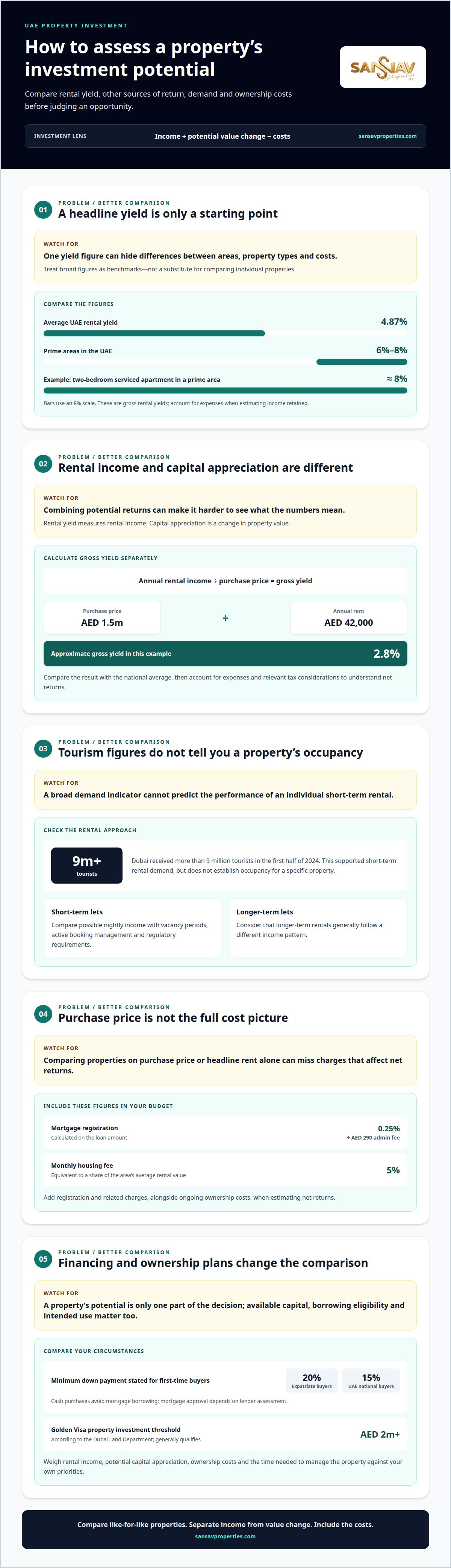
Compare expected rent and purchase value across different areas, then consider the property category. Prime areas in the UAE often deliver gross rental yields of 6% to 8%, while the average UAE rental yield is 4.87%. These figures are useful benchmarks, not a substitute for comparing individual properties and their costs.
A two-bedroom serviced apartment in a prime area, for example, has an approximate gross yield of 8% in the supplied rental example. Use the same calculation for each option, and avoid judging a property by headline yield alone.
-
Assess rental income and capital appreciation
Calculate gross yield by dividing annual rental income by the purchase price. A property bought for AED 1.5 million and rented for AED 42,000 annually produces an approximate gross yield of 2.8%. Compare that result with the national average, then account for expenses to understand the income retained.
Assess capital appreciation separately from rental yield: yield measures rental income, while appreciation is a change in property value. UAE property investment for beginners is easier to evaluate when these potential return sources are kept distinct. Include relevant tax considerations in your financial planning, as they can affect net returns.
-
Assess tourism and short-term rental demand
Consider whether visitor demand supports your short-term rental strategy. Dubai received more than 9 million tourists in the first half of 2024, supporting short-term rental demand. This broad indicator does not establish occupancy for a specific property.
Compare possible nightly income with vacancy periods, management needs and regulatory requirements. Short-term rentals require active attention to bookings, while longer-term lets generally follow a different income pattern.
- Choose cash or a mortgage according to your available capital and borrowing eligibility. According to the UAE Central Bank, first-time expatriate buyers must make a minimum down payment of 20%, compared with 15% for UAE national buyers. Cash purchases avoid mortgage borrowing, while mortgage approval depends on lender assessment.
Property ownership can support a residency application. According to the Dubai Land Department, an investment of at least AED 2 million generally qualifies for the Golden Visa.
Is Dubai real estate a good investment?
Property may generate rental income or capital growth, but returns depend on the asset, market activity and costs. Before deciding, compare similar properties and account for transaction fees and ongoing ownership charges.
-
Weigh investment benefits and risks
Consider demand and transaction activity alongside the potential for price changes and ownership costs. Real estate transactions exceeded AED 522 billion in the last 12 months, indicating substantial market activity, but this figure cannot predict returns from an individual property.
Weigh potential rental income and capital growth against running costs and the time needed to manage the property. Premium amenities may appeal to tenants, but the purchase price and ongoing expenses still shape overall investment performance.
-
Compare neighbourhoods and property prices
Assess each area against your budget, target tenant and preferred property type. Compare sale prices of similar homes, then consider nearby amenities and transport links that may influence tenant demand.
A premium area may appeal to certain buyers or tenants, but a higher purchase price means rental income must be assessed in context. Compare like-for-like properties rather than treating one area’s prices as a benchmark for the wider market.
-
Account for property fees
Include registration and related charges in your purchase budget. Mortgage registration costs 0.25% of the loan amount, plus an AED 290 administrative fee.
Also factor in the monthly housing fee, equivalent to 5% of the area’s average rental value. Add these costs when comparing properties and estimating net returns, rather than calculating from the purchase price alone.
-
Verify the developer, title and agent
Check that the developer or real estate agent has the required regulatory approval, and confirm that the title reflects the ownership being offered. The Dubai Land Department’s Escrow Account Service helps safeguard buyers and developers during transactions.
Professional real estate consultations can help you organise your priorities and questions about a transaction. A structured review is useful when comparing properties and understanding the documents involved in a purchase.
Use professional real estate consultations to bring your investment criteria into sharper focus.
Foreign ownership in designated freehold areas
Foreign buyers can own 100% of property in Dubai’s designated freehold areas. The right location and ownership structure depend on your investment goals and intended use.
- Confirm the area’s ownership category before selecting a property in Dubai. Foreign nationals can buy freehold or leasehold property only in designated areas of the UAE. In Dubai, foreign ownership is limited to approved freehold zones under Article 3 of Regulation No. 3 of 2006.
- Distinguish freehold ownership from leasehold rights before comparing properties. Freehold means owning the property in designated areas, while leasehold grants rights for a defined period. The tenure affects how you hold the asset and plan its role in your portfolio.
- Compare potential communities against your rental-income goals or intended personal use. Dubai Marina, Downtown Dubai and Palm Jumeirah are recognisable area names, but suitability depends on the individual property and your priorities. Consider amenities and access alongside the community’s appeal.
- Match the ownership option to your investment timeline. A buyer seeking long-term ownership may prioritise freehold, while another investor may consider leasehold rights. In either case, clarify the property’s tenure and associated rights before proceeding.
- Separate property ownership from residency planning. A property can form part of an investment portfolio and generate income, but the ownership arrangement and any residency application are distinct considerations. For Golden Visa eligibility, the Dubai Land Department states that a Dubai property investment of at least AED 2 million generally qualifies.
- Organise your decision around location, tenure and purpose. For example, compare an apartment intended to generate rental income with a property chosen for personal use. Before committing, confirm that the area permits the foreign ownership structure you want.
Property types, including residential, commercial, and off-plan
Choose a property type by matching its income potential, management needs and purchase timeline to your investment goals. Dubai offers residential, commercial and off-plan opportunities, each with distinct considerations.
-
Distinguish residential, commercial and off-plan properties
Start by comparing the asset’s intended purpose. Residential options include apartments, villas and townhouses; commercial property can include offices, retail spaces and industrial assets. Commercial and residential land offer different possibilities for development projects.
For example, a residential apartment may suit someone seeking rental income, while an office or warehouse serves a different tenant market. Consider who is likely to use the property and what management it will require.
-
Compare off-plan and ready properties
Compare the purchase timeline and payment structure. A completed property can be assessed in its present condition, while off-plan buyers may pay instalments until the project is completed.
For off-plan purchases, review the contract terms, development details and provisions for delayed completion. For a completed property, assess its condition and current rental potential. These differences can help beginners decide which route better suits their available capital and plans.
- Set your investment objective before narrowing the options. If you’re seeking rental income, compare apartments and villas with commercial spaces, considering their likely occupiers and management demands. If future growth is your priority, assess how the property’s value, intended use and location fit your holding plans.
- Match the choice to your experience and preferred level of involvement. A first-time buyer seeking a straightforward residential purchase may favour a completed apartment, while an investor comfortable with a longer timeline may consider off-plan property. Commercial assets may suit those assessing business tenants or industrial uses.
- For off-plan opportunities, explore off-plan property investment and compare suitable options with your priorities before choosing a purchase route.
SANSAV Properties: Off-Plan Property Investment
SANSAV Properties LLC helps investors compare off-plan opportunities with completed homes and rental options. Its professional real estate consultations help clarify priorities such as intended use, investment timeline and preferred property type before you choose a direction.
Explore off-plan property investment if you're considering a property under development, or secondary market residential sales for a completed home. Residential rental listings can help you consider available homes in light of your rental plans. Each route involves different decisions, so comparing them can help focus your search.
Bring your investment goals and preferred property type to a consultation to discuss which route best aligns with them. Contact SANSAV Properties LLC to talk through your property investment plans, especially when navigating UAE property investment for beginners.
Make your next property decision with purpose
A considered approach to UAE property investment for beginners starts with a clear priority: the kind of property and investment experience you want. Let that guide your next conversation, whether you’re exploring a development or weighing a completed home or rental property.
SANSAV Properties offers Off-Plan Property Investment, Secondary Market Residential Sales and Residential Rental Listings. These options provide different starting points for a property search shaped around your plans, whether you’re considering a future purchase or exploring rental possibilities.
Share your preferences and discuss which direction suits your goals. Contact SANSAV Properties to discuss your options and take a thoughtful next step towards your UAE property plans.
Frequently Asked Questions
Can you own 100% property in Dubai?
Yes, foreign buyers can own 100% of a property in Dubai’s designated freehold areas. This is different from leasehold ownership, which grants rights for a defined term; Dubai leasehold property is typically granted for 99 years, after which ownership reverts to the freeholder. Before choosing, consider whether you want full ownership or time-limited rights, and how that tenure suits your plans.
Is it better to invest in an apartment or villa in Dubai?
Neither is automatically better; choose according to your income goals, budget and management preferences. An apartment may suit an investor seeking rental demand in a central location, while a villa may appeal to someone prioritising potential long-term capital appreciation. Compare likely tenants, upkeep and your expected holding period rather than judging by property type alone.
Is it helpful to work with a local agent?
A real estate agent can help you understand property options, transaction steps and market context. In Dubai, a rental agent should be able to show a RERA card confirming they are acting legally. For example, an agent can help compare a completed apartment with an off-plan option and explain how each fits your investment priorities.
So, how do I make money?
Property investors generally seek rental income, growth in property value or both. Rental income may provide recurring returns, while appreciation may create a gain if you sell for more than your total acquisition and ownership costs. Assess expected rent alongside maintenance, vacancy and transaction expenses rather than treating gross rental income as profit.
What is the outlook for the UAE real estate market?
The UAE market outlook depends on demand, available property and conditions in each emirate. Dubai’s real estate transaction value increased by 36% over the previous year, indicating strong recent market activity, but transaction growth alone cannot predict future prices or returns. For your decision, consider the property’s location, intended use, rental prospects and the length of time you plan to hold it.
What is the gross rental yield?
Gross rental yield is the annual rent expressed as a percentage of the property’s purchase price, before expenses. Calculate it by dividing annual rent by purchase price, then multiplying by 100. For example, compare two properties using the same calculation, then consider that service charges, maintenance, vacancy and management costs reduce the income remaining after expenses.


