

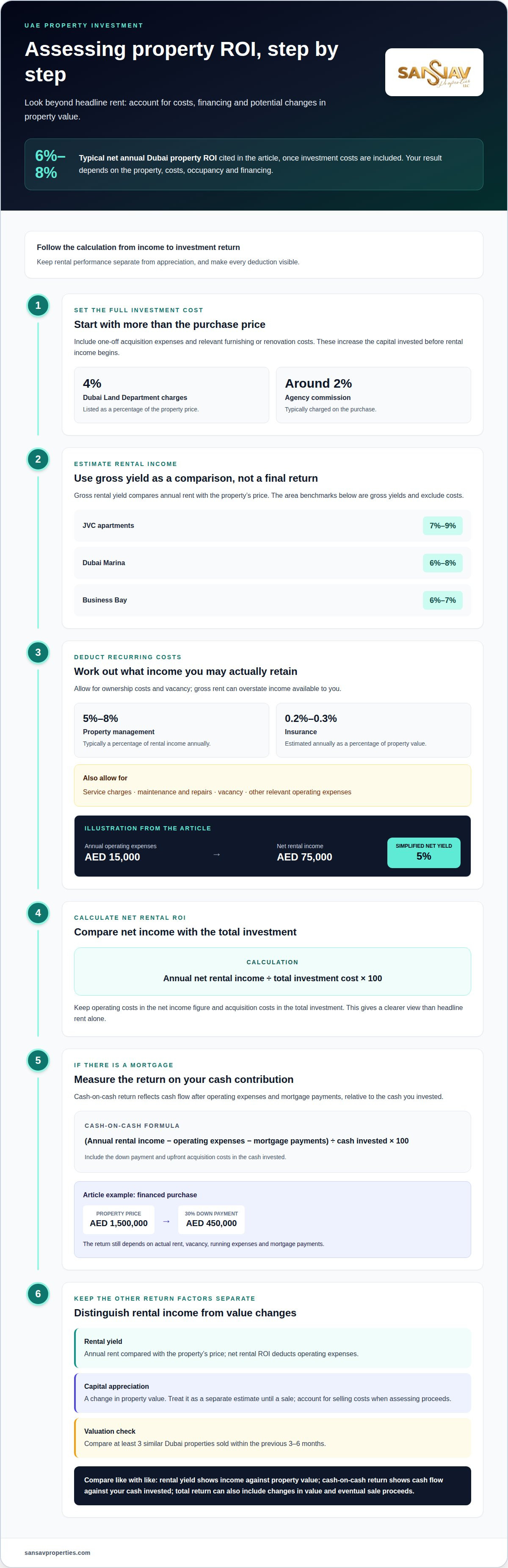
A good Dubai property ROI is typically 6%-8% net annually, once investment costs are included. Knowing how to assess UAE property ROI means looking beyond headline rent to the income left after costs, and separating rental returns from any potential capital appreciation. Financing also changes the picture: the return on your cash invested can differ from the property’s overall yield.
A headline return can look attractive, but it tells only part of the story. To understand how to assess UAE property ROI, calculate gross and net rental yield, include acquisition and ongoing expenses, and account for financing and changes in property value. Rental demand, vacancy and property type also affect the result, helping you judge an investment against your objectives.
Key Takeaways
- Separate rental income from potential capital appreciation to see how each contributes to the overall return.
- Include service charges, maintenance, management and other operating costs to estimate the income you may actually retain.
- Assess a mortgaged property against the cash you invest, accounting for financing outflows as well as rental income.
- Consider location, property type, rental demand and vacancy when judging whether projected returns are sustainable.
Should Capital Appreciation Be Included in ROI?
Include appreciation when assessing total returns, but keep it separate from rental performance. This shows whether the result is driven by income or a potential future sale.
Rental Yield and Capital Appreciation
Rental yield compares annual rent with a property’s price, while appreciation measures changes in its value. Together, they describe different parts of an investment’s potential return. Net rental ROI deducts operating expenses before comparing income with invested capital. Cap rate measures property income relative to value, while IRR accounts for the timing of cash flows, including purchase and sale. For a clear comparison, assess rental performance separately from projected appreciation.
Prices and Rents by Area and Property Type
Rental benchmarks also vary: JVC apartments are listed at 7%-9% gross yield, Dubai Marina at 6%-8%, and Business Bay at 6%-7%. These yields help compare income potential by area and type, rather than stating rent amounts.
Gross yield excludes costs, so it can overstate actual income. If annual operating expenses are AED 15,000, net rental income falls to AED 75,000, giving a simplified net yield of 5%. Vacancy and service charges can reduce retained income further. Keep these deductions visible when comparing properties.
According to Dubai Land Department, tenants are responsible for a municipality tax of 5% of the annual rent, shown separately on the electricity bill and distinct from the 5% VAT. Include relevant costs in the right place: tenant charges affect rental affordability, while owner expenses affect net ROI. Appreciation should remain a separate estimate until realised through a sale, with selling costs deducted from proceeds.
Service charges and ongoing operating costs
The purchase price alone understates the capital needed for a UAE property investment. Include acquisition expenses and recurring ownership costs to measure returns against the full outlay.
Ongoing Ownership Costs
Ongoing ownership costs are recurring expenses that reduce the income retained from a property. Insurance is estimated at 0.2-0.3% of property value annually. These costs vary with the property and its upkeep, so include them when estimating net income.
Property Management Costs
Property management costs cover managing a rental and are typically 5-8% of rental income annually. As a result, a change in annual rent also changes this expense. Include management alongside service charges, maintenance, insurance and vacancy allowance; otherwise, a gross rental figure can overstate the income available to you. Strong tenant demand may support occupancy, but it doesn’t remove the need to allow for operating costs.
Buying also brings acquisition costs. Dubai Land Department charges are listed at 4% of the property price, and agency commission is typically around 2%. These items increase the capital invested before rental income begins.
Build a complete cost picture by separating one-off buying expenses from recurring ownership costs. Include furnishing or renovation where relevant, then account for service charges, repairs, management and vacancy in the annual estimate. This makes comparisons between real estate opportunities more meaningful, even where rents or demand differ. For tailored guidance on the costs behind a property investment, professional real estate consultations can help frame the assessment.
Cash-on-cash returns for mortgaged properties
Cash-on-cash return compares annual cash flow with the investor’s cash contribution. It shows how financing affects the return on your own capital, rather than the yield on the property’s full value.
Use this formula: annual rental income, minus operating expenses and mortgage payments, divided by the cash invested, multiplied by 100. Include the down payment and upfront acquisition costs in the denominator. Keep the calculation distinct from rental yield, which compares rental income with property value. This makes returns from financed and unfinanced purchases easier to compare.
A simplified Dubai example uses a AED 1,500,000 property and a 30% down payment, equal to AED 450,000 in investor equity. The cash-on-cash result still depends on actual rent, vacancy, running expenses and mortgage payments. A tenant’s rent contributes to cash flow, but it does not represent the investor’s retained income. Deduct costs and debt payments before calculating the return on that AED 450,000 contribution.
Mortgage terms shape the outcome. A larger down payment increases the initial cash invested, while loan repayments reduce annual cash flow. Interest and repayment schedules also affect how much rental income remains. Compare scenarios using the same rent, expenses and ownership period, changing one financing assumption at a time. This helps reveal whether the cash flow comes from the property or the financing structure.
Cash-on-cash return does not show the full investment return. It excludes unrealised appreciation, while a total-return assessment can include rental cash flow, changes in property value and eventual sale proceeds. Keep these components separate and include selling costs when assessing a sale. This distinguishes immediate cash returns from gains that depend on property value, the mortgage balance and timing.
For a useful comparison, assess both cash flow and overall property value. High rental yield can still mean modest cash-on-cash returns if expenses and mortgage payments absorb much of the income. Lower borrowing costs or stronger occupancy can shift the balance.
What Factors Can Affect Property ROI in Dubai?
Returns depend on rental demand, total investment, financing and the reliability of property valuations. Include purchase costs and rental-related charges when comparing Dubai apartments or building a portfolio.
Property Valuation and ROI Calculation
Valuation estimates a property’s worth, while ROI compares its net income with total investment. To assess value, compare at least three similar Dubai properties sold within the previous 3-6 months. Calculate annual net rental income divided by total investment cost, then multiply by 100. Include acquisition costs: the Dubai Land Department purchase fee is 4% of the property price, agency commission is typically around 2%, and mortgage processing is around 1% of the loan.
Using a Dubai Property ROI Calculator
A Dubai property ROI calculator organises purchase, rental and expense assumptions into an estimated return. For example, one displayed calculation uses a AED 2,500,000 property value, AED 3,000,000 total investment, AED 180,000 annual rental income and AED 25,000 annual expenses. Change the inputs to test how rent, vacancy or costs affect the result. A calculator supports comparison, but its output depends on the figures entered.
For rental properties, include applicable tenancy registration charges in your cost model. The amount depends on the emirate and registration process, so account for it when estimating rental income and expenses.
Taxes and Investment Returns
Dubai property tax, VAT and rental charges affect different parts of the return calculation. Dubai property is described as having a 0% property tax rate, while capital appreciation should be modelled separately from rental income. According to Dubai Land Department, tenants are responsible for a municipality tax of 5% of the annual rent, shown separately on the electricity bill and distinct from the 5% VAT.
Include purchase registration charges and agency commission in total investment, then account for mortgage-related costs where relevant. For support applying these factors to an investment decision, explore professional real estate consultations.
SANSAV Properties
SANSAV Properties LLC can help you bring rental income, operating costs and potential appreciation into one considered investment decision. Through professional real estate consultations, you can discuss the assumptions behind an ROI estimate and how location, property type and rental demand relate to your objectives.
If you're comparing an off-plan opportunity with a secondary-market property, SANSAV Properties LLC can help you assess how each fits your investment horizon and income expectations. Its residential rental listings also let you explore properties with rental potential, keeping costs and expected cash flow central to the decision.
For a measured conversation about your UAE property investment, contact SANSAV Properties LLC.
Make your next investment decision with clarity
Knowing how to assess UAE property ROI gives you a framework for deciding whether an opportunity fits your priorities. Connect the figures with your investment horizon, preferred level of involvement and tolerance for changing rental conditions. A return estimate is most useful when it supports a clear decision, rather than standing alone as a headline figure.
Decide what you want your property investment to achieve, then bring those priorities into a focused discussion. SANSAV Properties can help you explore options and assess how they fit your plans, whether you’re refining your investment approach or starting to consider opportunities in the UAE.
Contact SANSAV Properties to discuss your investment and take a considered next step towards your property goals.
Frequently Asked Questions
What Is a Good ROI in Dubai?
A useful benchmark for Dubai property is an annual net ROI of 6%-8%. Net and gross returns measure different things, so compare like with like: gross yield excludes costs, while net ROI reflects expenses against investment. Also consider the holding period and whether you prioritise regular rental income or potential value growth when deciding whether a return suits your plans.
What does ROI mean in the Real Estate Market?
ROI, or return on investment, expresses a property’s return relative to the capital invested, as a percentage. To understand how to assess UAE property ROI, distinguish rental profit from changes in property value and use the same time period and cost basis for each comparison. Otherwise, a higher-looking result may simply reflect a different calculation, not stronger performance.
What Influences ROI and Yield?
Rental demand, achievable rent, vacancy, property type and operating expenses all influence yield and ROI. Financing also affects cash returns because repayments reduce the income an investor retains. Knowing how to assess UAE property ROI means considering how location affects tenant demand and resale potential. Compare properties using consistent assumptions, then assess how each asset’s income pattern fits your portfolio.
How is gross rental yield calculated for UAE property?
Divide the expected annual rent by the property’s purchase price, then multiply by 100. For example, a property costing AED 1,000,000 with annual rent of AED 80,000 has a gross yield of 8%. This is a quick comparison measure, not the income you keep: it excludes ownership expenses, acquisition costs, vacancy and financing payments.
How do you calculate net rental yield after service charges, maintenance, and management fees?
Subtract annual operating expenses from annual rent, divide the remaining rental income by the property price, then multiply by 100. Include service charges, maintenance, management costs and an allowance for vacancy in the expense total. Keep acquisition costs separate if calculating net yield against the purchase price; include them in total investment when calculating ROI on all invested capital.
What are typical rental yields in Dubai, Abu Dhabi, and other UAE emirates?
Dubai residential properties commonly achieve gross rental yields of around 5%-8%. Figures for other emirates may use a different measure: property ROI estimates are 5%-7% in Abu Dhabi investment zones and 6%-8% in Sharjah and the Northern Emirates. Treat these as distinct benchmarks, not a direct ranking, unless each figure uses the same yield definition and cost basis.


