

The commitment comes before the keys. An off-plan property in the UAE is part of a development that is still being planned or built, so in Dubai you buy before the home is complete. That timing is the defining difference from purchasing a finished property.
It’s natural to focus on the launch price, but a suitable project also needs to fit your budget, preferred location and reason for buying. This guide explains what off-plan property means in the UAE and how to compare projects against those priorities. You’ll see how launch prices vary, what to consider beyond the headline figure, and how your goal can shape the choice, whether you’re planning a future home or considering an investment. With a clearer view of the options, you can weigh projects more confidently and focus on what matters before deciding.
Key Takeaways
- Understand how buying before completion differs from purchasing a ready property, and what that means for your decision.
- Explore Dubai’s varied off-plan locations and learn how to read launch listings beyond the headline price.
- Compare projects by budget, location, delivery timing and investment goal to narrow your options.
- See how SANSAV Properties’ off-plan investment service and professional real estate consultations can support your next steps.
What does off-plan mean in Dubai?
Dubai off-plan properties are developments still in planning or construction, rather than completed homes. Buyers commit before handover, so the purchase involves a future residence, not immediate occupation. Construction takes between 2 and 5 years on average, depending on development scale and location. That timeframe makes the delivery schedule and payment plan central to assessing each opportunity.
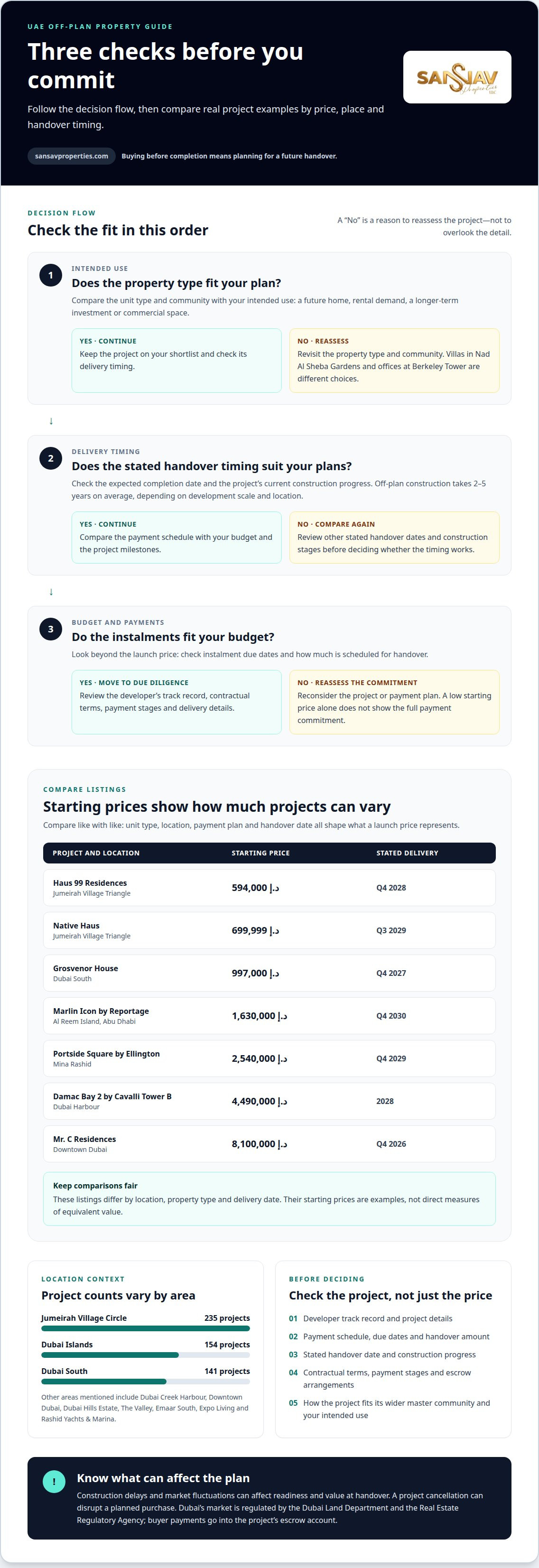
Developments span established and emerging areas. Jumeirah Village Circle has 235 listed projects, while Dubai Islands has 154. Other locations include Dubai Creek Harbour, Downtown Dubai, Dubai Hills Estate, The Valley, Emaar South, Expo Living and Rashid Yachts & Marina. Dubai South has 141 listed projects. These areas offer different settings and property types, from residences near Dubai Creek to townhouses in master-planned communities.
Developers with named projects include Emaar, Ellington, Damac, Imtiaz and Meraas. Examples include Valia Tower by Emaar in Dubai Creek Harbour, Meriva Shores by Ellington on Dubai Islands, and Kore by Imtiaz in Dubai Land Residence Complex. A developer delivers the building; a master-community developer shapes the wider setting and its planned community environment. Distinguishing the two helps you assess both the property and its surroundings.
Before selecting a project, examine its details, the developer’s track record, payment schedule and stated handover timing. Consider how it fits its master community and your intended use. Dubai’s market is regulated by the Dubai Land Department and the Real Estate Regulatory Agency, and off-plan buyer payments go into the project’s escrow account. International buyers can purchase off-plan property in designated freehold zones across Dubai.
The key risks are construction delays and market fluctuations, which can affect when a property is ready and its value at handover. A project cancellation can disrupt your planned purchase and delay your intended use or investment strategy. Reviewing the contractual terms, payment stages, escrow arrangements and delivery details helps clarify your commitments before proceeding.
Dubai off-plan project listings and launch prices
Compare each listing by location, starting price and handover timing, rather than price alone. Non-UAE nationals can buy off-plan in designated Dubai freehold zones. Property may also be relevant to Golden Visa planning, although residency eligibility is a separate consideration.
Project listings by location
Grosvenor House in Dubai South starts from د.إ 997,000, with delivery listed for Q4 2027. In Jumeirah Village Triangle, Haus 99 Residences starts from د.إ 594,000, with delivery in Q4 2028; Native Haus starts from د.إ 699,999, with delivery in Q3 2029. Portside Square by Ellington at Mina Rashid starts from د.إ 2,540,000, with delivery in Q4 2029. These examples show how budget and timing vary between communities.
Launch prices and escrow accounts
Compare like with like: unit type, location and handover date all shape what a launch price represents. Mr. C Residences in Downtown Dubai starts from د.إ 8,100,000, with delivery listed for Q4 2026. Damac Bay 2 by Cavalli Tower B in Dubai Harbour starts from د.إ 4,490,000, with handover in 2028. Dubai’s real estate market is regulated by the Dubai Land Department and the Real Estate Regulatory Agency, which require developers to use escrow accounts and follow buyer-protection regulations. Buyer payments go into the escrow account for that project.
Buying typically involves choosing a developer, reviewing the payment plan, then completing legal and financial processes as the project reaches completion. Compare instalment due dates with your budget, and note how much is scheduled for handover. A low launch price alone won’t reveal the full payment commitment.
For a wider UAE comparison, Marlin Icon by Reportage on Al Reem Island, Abu Dhabi, starts from د.إ 1,630,000, with delivery listed for Q4 2030. Launch prices and handover dates can vary between listings, so compare each project’s details before drawing comparisons. These listings help buyers compare emirates, districts and delivery dates without treating unlike properties as direct equivalents.
Comparing projects by budget, location and investment goals
Compare property type, location, price and handover timing together. For investors, construction progress and payment plans also help determine whether a project fits their plans.
Location, amenities and infrastructure
Start with the setting and the community’s planned infrastructure, then consider how each suits your intended use. Nad Al Sheba Gardens by Meraas offers villas in Nad Al Sheba, while Berkeley Tower brings offices to Business Bay. These are different real estate choices, so assess each project’s stated facilities and surrounding community rather than assuming every development offers the same amenities.
For projects in Dubai, connect location to your goal: a future home, rental demand or a longer-term investment. A villa in Nad Al Sheba Gardens may suit buyers seeking a residential property, while offices at Berkeley Tower may appeal to investors considering commercial space. Compare the unit type and community setting before treating two projects as equivalent.
Starting prices and handover timing
Starting prices and handover timelines vary by project, so compare each listing’s stated details. Berkeley Tower offices start from د.إ 5.09 million, with handover listed for 2031. The difference reflects distinct property types and locations, so compare each starting price alongside its use, payment plan and delivery timing, not as a standalone measure of value.
Construction status matters because a listed handover date and the project’s current stage answer different questions. Review the stated construction progress alongside the expected completion date, then consider how the payment plan aligns with those milestones. Serro 2 at The Heights has an expected handover in Q2 2030; that date gives investors a useful timeline for weighing their plans against the project schedule.
Use a consistent comparison: intended use, unit type, community infrastructure, construction stage, payment plan and handover. Alva at The Valley by Emaar is listed at د.إ 4.38 million, while Hayat 7 by Dubai South is listed at د.إ 4.8 million. Compare each project’s property type and stated details before deciding which better matches your budget and investment goal.
Definition of off-plan property
An off-plan property is a home or unit bought before its development is complete. In Dubai, it may still be in planning or construction when the buyer commits. The purchase is for a future apartment, villa or residence, rather than a completed home available for immediate occupation. That timing is the essential distinction, and it shapes how buyers plan for payment and use.
At launch, buyers select from the units and specifications offered for the project. The agreed purchase terms describe the selected property and its payment plan. For example, a 40/60 plan means 40% is paid during construction and 60% at handover. A 50/50 plan divides payments equally between the period before completion and handover, while a 60/40 plan places 60% during construction and 40% at handover.
This explains why a launch price is only one part of the decision. Understand which unit the price applies to, when instalments fall due and the stated delivery timing. An apartment in a Dubai Marina development and a villa in Jumeirah differ in type and location, even if both are off-plan launches. Those distinctions matter when considering off-plan property in the UAE.
Project stage offers another useful point of comparison. A development in planning has a different construction status from one already being built, although both are incomplete. The stated handover date helps you consider whether the schedule suits your plans. A future home, rental investment or luxury residence may call for different choices around location, unit type and payment timing in the UAE’s off-plan property market.
The practical takeaway is simple: “off-plan” describes when you buy, not a particular property style. Use the project specifications, construction stage, payment plan and handover schedule to understand the commitment. To discuss a suitable off-plan property investment, consider how these details align with your goals.
SANSAV Properties: Off-Plan Property Investment
SANSAV Properties offers Off-Plan Property Investment for buyers considering a future home or property investment in the UAE. Its Professional Real Estate Consultations can help you assess how a project’s location, unit type, payment plan and handover timing align with your priorities.
If you’re also weighing a completed home or rental potential, Secondary Market Residential Sales and Residential Rental Listings offer relevant alternatives to consider alongside an off-plan purchase. This helps you decide whether you want a property under development, a completed home to buy, or a rental listing to explore.
Share your preferred location, budget and intended use to begin a focused conversation. Contact SANSAV Properties to discuss your property plans.
Shape your next property decision
Turn your priorities into a clear brief: the kind of property you want, the role it should play in your plans, and the features that matter most. This gives your search for off-plan property in the UAE a practical direction, helping you focus on suitable opportunities rather than browsing without a defined purpose.
SANSAV Properties offers Off-Plan Property Investment, alongside Secondary Market Residential Sales and Residential Rental Listings. These options help frame a decision about buying before completion, considering a completed home, or exploring a rental property. Choose the route that best reflects your plans, then discuss the priorities you want your property search to address.
Contact SANSAV Properties to discuss your property goals and take a considered next step.
Frequently Asked Questions
Why Invest in Dubai Housing?
The UAE market offers buyers a choice of completed homes and properties still under development, across different communities and property types. Investors may consider potential appreciation, rental use or future personal occupancy, but each depends on the property and market conditions. Non-UAE nationals can buy off-plan in designated Dubai freehold zones, making location eligibility a practical factor when assessing a purchase.
What is an Off-Plan Property?
An off-plan property is purchased before the development is complete, while it is still being planned or built. You commit to a specified unit for future delivery rather than taking possession of a finished home. For example, a launch may offer different apartment layouts within one project. The unit specifications, contractual terms and payment schedule define what you’ve agreed to purchase.
What are the current off-plan property prices in Dubai, Abu Dhabi, and other UAE emirates?
Listed starting prices vary by project, property type and emirate. Dubai examples include Meriva Sunset on Dubai Islands from د.إ 3,430,000 and The Edit at D3 from د.إ 2,000,000. In Abu Dhabi, Brabus Island Residences is listed from د.إ 2,500,000. Alaya at Zorah Island has an indicative starting price of د.إ 425,000. Treat listing prices as project-specific examples, not emirate-wide averages.
What are the UAE laws and buyer protections for off-plan property purchases?
In Dubai, the Dubai Land Department and the Real Estate Regulatory Agency regulate the real estate market. Developers must use escrow accounts and follow regulations intended to protect buyers. Payments for an off-plan project go into that development’s project escrow account. These details concern Dubai; buyers considering projects in other emirates should understand the applicable local framework and project terms.
How can buyers verify a developer and project registration in the UAE?
For a purchase in Dubai, use Dubai Land Department and Real Estate Regulatory Agency information as reference points when reviewing the project and developer. Match the project identity across its sales documents, payment details and escrow information, and ensure the named developer is consistent throughout. For a project in another emirate, begin with the relevant local authority’s records and compare them with the contractual documents.
What are the steps to buy an off-plan property in the UAE?
Begin by choosing a project and unit that suit your intended use, then review the developer’s terms, payment plan and delivery details. Confirm that the payment instructions relate to the project escrow account in Dubai. Before committing, read the purchase documents closely so the unit description and instalment schedule are clear. Complete the required legal and financial processes as the project reaches completion.


