

An off-plan home may cost less upfront than a comparable ready property, but the discount comes with waiting and construction risk. The main off-plan property investment risks in the UAE include delayed handover, changing market values before completion and payment obligations that continue if circumstances shift. Legal remedies may apply when a delay amounts to a breach, but the contract and reason for the delay matter.
It’s understandable to weigh a lower purchase price against the certainty of a ready home, which you can inspect and potentially rent sooner. This guide explains how the options compare, why discounts vary, which risks deserve attention and what remedies may be available for undue delays. You’ll also see how payment terms, project progress and the Sale and Purchase Agreement shape the decision, helping you assess an off-plan opportunity more clearly.
Key Takeaways
- Assess a developer’s track record and ability to complete the project, as these can shape both construction progress and the finished property.
- Read the Sale and Purchase Agreement for payment stages, milestones, completion dates and provisions dealing with delay.
- Compare off-plan and ready homes by weighing the purchase price against handover timing and when the property could begin generating rental income.
- Understand which contractual and civil remedies may apply to undue delays, and how the reason for the delay can affect a claim.
What are the available legal remedies if an off-plan project undergoes undue delay?
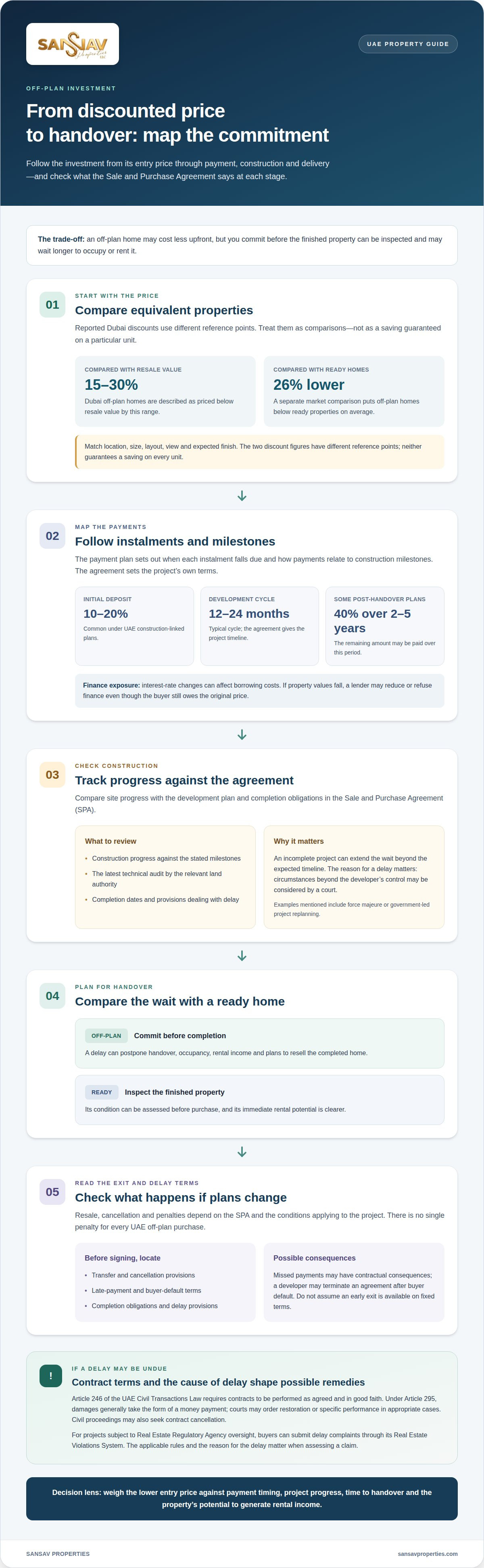
In the UAE, Article 246 of the Civil transactions Law under Federal Decree Law No. (5) of 1985 requires contracts to be performed as agreed and in good faith. Article 295 provides that damages generally take the form of a money payment, while courts may order restoration or specific performance in appropriate cases.
Insolvency and advance payment losses
If a developer becomes insolvent before construction is complete, buyers may be unable to recover money already paid. That makes the developer’s financial and delivery record important, not just the project’s design. Before committing funds, examine completed projects, construction progress and the developer’s ability to meet its stated obligations. A strong track record can help you assess delivery capability, but cannot eliminate the possibility of financial loss.
Buyer protections and escrow rules
Project registration and regulated payment arrangements can connect buyer payments to development activity. Off-plan registration and escrow requirements depend on the rules governing the project; where a regulated escrow account applies, payments are channelled through that account. Article 6 of Law No. (7) of 2006 requires real property rights to be registered with the Dubai Land Department, according to the Dubai Legislation Portal. These safeguards do not guarantee recovery if a developer becomes insolvent.
For projects subject to Real Estate Regulatory Agency oversight, buyers can submit delay complaints through its Real Estate Violations System. Article 22 of Executive Council Resolution No. (6) of 2010 sets out circumstances in which a developer may be considered negligent or to have omitted obligations. Examples include unjustified delays securing land, approvals or construction preparations, and sales without required master-developer approval.
Civil proceedings before UAE Civil Courts may seek specific performance, contract cancellation or damages. A court may consider whether circumstances beyond the developer’s control caused a delay, including force majeure or government-led project replanning.
Due diligence should cover the developer’s past projects, land status, permits and project approvals. Compare progress with the Sale and Purchase Agreement, including completion obligations and delay provisions. These checks can help distinguish poor project management from delays that may have a valid external cause.
How does off-plan compare to ready property?
You can view a ready property before purchase, and it may support earlier rental plans. With an off-plan property, you commit before completion, making payment stages and construction progress central to the investment.
Payment structures and milestones
A payment plan sets out when instalments fall due and how they relate to construction milestones. In the UAE, buyers commonly pay an initial deposit of 10% to 20% under construction-linked plans. Developments typically have a 12-24 month development cycle, though the Sale and Purchase Agreement sets the project’s own timeline. Some UAE post-handover plans let buyers pay the remaining 40% over 2 to 5 years. Interest-rate changes can affect borrowing costs, while falling property values may lead a lender to reduce or refuse finance, even if the buyer still owes the original price.
Delays and rental or resale plans
Construction delays can postpone handover, rental income, occupancy and plans to resell a completed home. A ready property, by contrast, can be assessed in its finished condition, and its immediate rental potential is clearer. Compare site progress with the development plan in the Sale and Purchase Agreement, then review the latest technical audit conducted by the relevant land authority. An incomplete project may extend the wait beyond the expected timeline.
Resale, cancellation and penalties
Reselling or cancelling before completion depends on the Sale and Purchase Agreement and applicable project conditions. No single penalty applies to every UAE off-plan purchase. Buyers who miss payments may face contractual consequences, and developers may terminate agreements after buyer default. Read the transfer, cancellation, late-payment and default provisions before relying on an early exit.
Purchase costs and fees
Allow for registration and administration charges in addition to the purchase price. The applicable amounts depend on the emirate and transaction, so include the fees set out in the purchase documents when calculating the total funds required. These costs affect more than the initial instalment. A professional real estate consultation can help you weigh the payment schedule against your investment plans.
Off-plan purchase discounts compared with resale and ready properties
Off-plan buying trades a lower entry price for a home that is not yet finished. In Dubai, reported discounts vary, so compare the specific unit and its purchase terms rather than relying on one headline figure.
Off-plan definitions and discounted pricing
An off-plan property is purchased before completion, with the future home described through the developer’s design or development plans. Buyers therefore commit capital without being able to inspect the finished property.
Dubai off-plan homes are described as priced 15-30% below resale value, while another market comparison puts them 26% below ready properties on average. These figures offer different reference points, not a guaranteed saving on every unit. A fair comparison matches location, size, layout, view and expected finish, then accounts for payment timing and purchase costs. For example, comparing a compact off-plan apartment with a larger ready home would distort the apparent discount.
The initial price is only one part of value. Consider how much capital will be tied up before completion, when each payment is due and whether the planned property suits its likely future residents. Two homes are not equivalent simply because one has a lower asking price, particularly if their specifications or surroundings differ.
Discount potential and capital growth
A discount may leave room for capital growth if the completed property’s value rises relative to its purchase price. This potential is most relevant to investors prepared to hold the asset through construction and assess returns over a medium- to long-term horizon.
Growth depends on the property’s location, delivered quality and demand at completion. A strong design on paper cannot establish its eventual market value. Compare the developer’s plans with nearby ready homes, taking account of their features and position, then consider whether the price gap reflects the wait and construction exposure.
The resale value at completion may differ from today’s expectations as market conditions change. Treat projected growth as an investment scenario, not as cash available for a deposit or later instalments. A discount is useful only if the purchase price, payment schedule and eventual market appeal align with your capital plans.
Off-plan property investment risks in the UAE
An attractive launch price can obscure risks that emerge before handover. In the UAE, construction issues, funding changes and permit delays can disrupt project schedules. Buying off-plan means committing to a future asset, so consider how market changes, developer performance and payment obligations interact. Assess the whole investment structure, not just the launch offer.
Construction delays can postpone completion, and an unfinished project cannot provide the expected use or rental income. Compare progress with the development plan and the milestones in the Sale and Purchase Agreement. In Dubai, RERA and the Dubai Land Department monitor project escrow accounts and construction milestones. A gap between observed progress and agreed stages deserves attention, as it may affect later payments and your investment plans.
Market risk continues throughout construction. If property values fall before completion, a lender may reduce or refuse financing, while the buyer may still owe the original purchase price. Values in Abu Dhabi may also decline or fail to rise as expected by handover. Changes in market conditions and regulations can affect medium- and long-term returns. In Abu Dhabi, buyers should understand late-payment penalties and default consequences because developers may terminate Sale and Purchase Agreements after buyer default.
Project suitability matters as much as price. Confirm that land status and permits align with the intended use, and consider nearby essential services, infrastructure and planned development. These factors can shape the finished property’s appeal and its potential demand. For Abu Dhabi projects, review government approvals and regulated escrow arrangements alongside the payment schedule. A clear view of these elements helps distinguish an appealing opportunity from one whose assumptions depend on uncertain timing or demand.
Bring the project, payment structure and investment goals together before committing. Arrange a professional real estate consultation to discuss how an off-plan opportunity fits your plans.
SANSAV Properties: Off-Plan Property Investment
SANSAV Properties LLC helps investors assess off-plan opportunities against their priorities and intended holding period. Its Off-Plan Property Investment service supports buyers weighing a project’s payment structure, expected completion and potential against construction uncertainty and future market conditions.
Professional Real Estate Consultations can help bring the key considerations together. Secondary Market Residential Sales and Residential Rental Listings offer alternatives if you prioritise a completed home or rental property. This broader perspective can help you decide which route better fits your objectives, without treating an attractive launch price as the only measure of value.
Contact SANSAV Properties LLC to discuss your property investment plans.
Choose the property route that fits your next move
Your next step is to turn your investment priorities into a clear decision: define your intended holding period, appetite for construction exposure and plans for the property once it is ready. This helps keep off-plan property investment risks in perspective, rather than letting a launch price or projected growth drive the choice alone.
SANSAV Properties offers Off-Plan Property Investment, Secondary Market Residential Sales and Residential Rental Listings. These options support different goals, whether you are considering a future home, a completed property or a rental opportunity. Speak with SANSAV Properties to explore which direction best reflects your objectives and the trade-offs you are prepared to make.
Contact SANSAV Properties to discuss your options and take your next property decision forward with greater clarity.
Frequently Asked Questions
What is off-plan investment?
Off-plan investment means buying a property before construction is complete, based on the developer’s plans and contractual description. You commit before viewing the finished home, so the written specification carries particular weight. For example, review how the unit, finishes and delivery obligations are described, then compare those terms with your expectations. This approach can suit buyers seeking future value, but requires patience through construction.
What are the risks of buying off-plan in Dubai?
The main off-plan property investment risks include construction delays, developer financial difficulty and changing market values before handover. A delay can disrupt plans to occupy, rent or resell, while a fall in values may affect financing. In Dubai, compare progress with the Sale and Purchase Agreement’s milestones and consider whether your finances can meet scheduled payments if completion or resale takes longer than planned.
What are the essential factors to consider when investing?
Start with your purpose: a future home, rental income or longer-term capital growth calls for different priorities. Consider how long your capital will be committed, whether the payment schedule fits your cash flow and whether the planned features support the property’s intended use. For example, if you rely on immediate rental income, account for the wait until handover rather than treating projected rent as available cash.
What are the main risks of buying off-plan property in the UAE?
Across the UAE, consider delayed or incomplete construction, changing market conditions, payment default and possible developer insolvency. A project’s location and intended use also matter: planned infrastructure or nearby services may affect demand, while regulatory changes can influence future value. Assess each risk against your holding period and financial capacity instead of assuming a lower launch price will offset every uncertainty.
How can buyers verify a UAE off-plan project and developer before paying?
Confirm the developer’s registration with the Dubai Land Department and its real estate developer licence from the Real Estate Regulatory Agency. Check that the project is registered, with off-plan registration through Oqood, and establish whether payments go into a regulated escrow account. Then compare the Sale and Purchase Agreement with the project’s land status, permits, unit details, payment milestones and stated completion obligations.
What happens if a UAE off-plan project is delayed, cancelled or the developer defaults?
In Dubai, buyers can report development delays to RERA through its Real Estate Violations System. Depending on the circumstances and agreement, civil proceedings may seek specific performance, contract cancellation or damages. A court may consider whether factors outside the developer’s control caused the delay. If insolvency occurs before completion, buyers may be unable to recover advance payments, so payment records and contract terms matter.


